
SEO & AI Search
GEO vs SEO: What's Actually Different (and What Isn't)
GEO vs SEO, explained by a B2B SEO consultant. What generative engine optimization changes, what stays the same, and how to do both without burning out.

A practical B2B SEO strategy from a B2B SEO consultant: how B2B SEO differs from B2C, keyword research for buyers, BOFU pages, technical SEO, AI search, and measuring pipeline.


Quick answer
A B2B SEO strategy helps business buyers find you on Google and in AI search while they research a purchase. It starts with your buying committee's real questions, targets high-intent keywords first with bottom-of-funnel pages, fixes technical SEO, builds trust with proof and links, and measures success in pipeline, not traffic.
Key takeaways
B2B SEO isn’t B2C SEO with a longer sales cycle.
It’s a different game. Fewer searches. Bigger deals. More people in the room.
I learned that the slow way. I spent years publishing content that went nowhere before I built a system that worked. Traffic is easy to celebrate. Pipeline is harder.
Sound familiar?
This guide to B2B SEO is what I do now instead: a complete B2B SEO strategy built around buyers, not just rankings. It works for B2B SaaS, services, and fintech companies alike. It’s the same approach behind a content engine that brought one B2B client 464 SQLs and $294K+ in pipeline in 8 months.
B2B SEO is search engine optimization for companies that sell to other businesses. It helps decision makers find your product or service on Google and in AI search while they research a purchase, then turns that organic traffic into qualified leads.
Same tools as any SEO. Very different targets.
| What differs | B2B SEO | B2C SEO |
|---|---|---|
| Search volume | Low, often under 1,000 a month | High, often thousands or more |
| Deal size | Big: contracts, retainers, licenses | Small to medium, one-off purchases |
| Who decides | A buying committee | Usually one person |
| Sales cycle | Weeks to months | Minutes to days |
| Best content | Comparison pages, case studies, expert guides | Product pages, reviews, quick answers |
| What to measure | Demos, SQLs, pipeline | Sales, revenue per visit |
Here’s the part that trips up most B2B marketers: low search volume isn’t a weakness.
Look at two keywords from my own niche (Ahrefs, US, November 2026):
Fewer searches. Much higher value. The cost per click tells you who’s ready to buy.
Before keyword research, I map who’s actually in the room.
In a typical B2B purchase, that’s more than one stakeholder: the user who feels the pain, the manager who owns the budget, and someone who has to approve the risk, like finance, IT, or legal.
Each of them searches differently.
Talk to your sales team. Read call notes. List the questions and pain points that come up before every deal.
Those questions, and how these people are searching for solutions, are your B2B keyword strategy.
Most B2B blogs start at the top of the funnel, with “what is” articles. That’s backwards.
I start at the bottom, closest to revenue:
Map one primary keyword to one page. Two pages chasing the same keyword compete with each other, and usually both lose.
This is the unglamorous part. Do it anyway.
Fundamentals first, always:
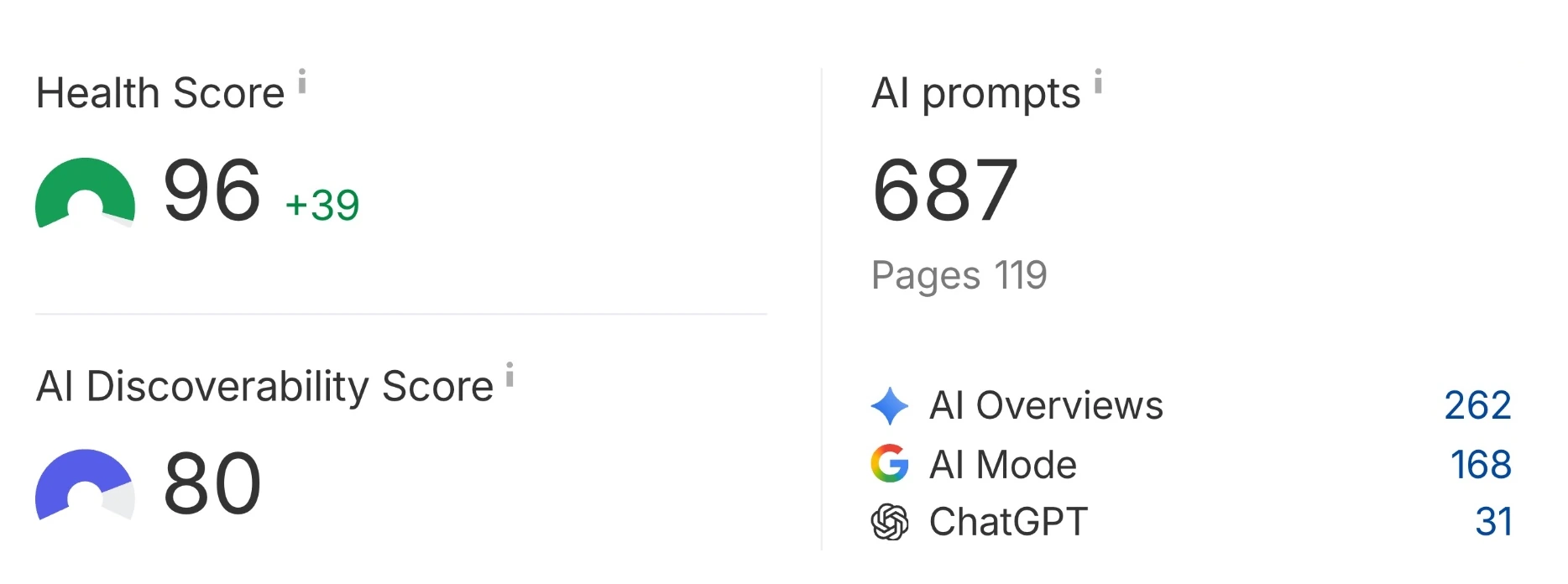
For a B2B ecommerce brand I worked with, fixing technical SEO first lifted their site Health Score by 39 points, to 96. Everything we published after that had a better chance.
Once the foundations are solid, build in this order:
Money pages first. One landing page per service or product, with a clear answer, proof, and a call to action. Then comparison and alternatives pages. This is where lead generation happens.
Then pillar pages and clusters. A pillar page covers a broad topic. Shorter supporting posts answer specific questions and link back to it. This shows search engines you cover the topic in depth.
Then thought leadership. Original data, expert opinions, and lessons from real projects. This is the B2B content marketing that earns links, mentions, and AI citations.
Every piece of content should answer one question clearly, in the first two sentences. Then explain.
B2B buyers are skeptical. So are search engines, especially in YMYL industries like finance and health.
Trust signals every B2B website needs:
Then build authority beyond your own site. Write for industry publications, join podcasts, share on LinkedIn (SEO and social media work better together), and earn links through digital PR. B2B link building is slower than B2C. One link from a respected trade publication is worth more than a hundred directory links.
Your buyers aren’t just searching Google anymore. They’re asking ChatGPT, Perplexity, Gemini, and Google’s AI Overviews.
The good news: most of the work overlaps. An Ahrefs study of 1.9 million AI Overview citations found that 76.1% of cited pages already ranked in Google’s top 10.
So strong SEO gets you most of the way. On top of that:
I go deeper on this in GEO vs SEO: what’s actually different.
Here’s where most B2B SEO campaigns quietly fail. They report rankings and traffic. Leadership asks about revenue. Nobody can connect the two.
Track these, in this order:
Not sure what SEO could be worth to you? Plug your numbers into my free SEO ROI calculator.
If this feels like a lot, here’s the short version:
Know your buyers’ questions. Fix the foundations. Build the bottom of the funnel first. Prove everything. Measure pipeline.
Then repeat. Minimum viable, then repeat.
That’s a B2B SEO strategy. Not glamorous. But it compounds.
If you’d rather have someone senior run it with you, this is what I do: B2B SEO and content marketing, built around pipeline.
Which step is your team stuck on right now? Tell me on LinkedIn. I’d love to hear what’s working, and what isn’t.
B2B SEO is search engine optimization for businesses that sell to other businesses. It helps decision makers find your product or service on Google and in AI search, and turns that organic traffic into qualified leads.
Start with bottom-of-funnel pages, fix technical SEO, write for the whole buying committee, earn trust with proof and links, and optimize for AI search. Then measure pipeline.
Yes, especially for high-ticket services and software with long sales cycles. Buyers research online before they talk to sales, and SEO puts you in that research.
B2B SEO targets lower-volume, higher-intent keywords, longer sales cycles, and several decision makers per purchase. B2C SEO usually targets higher volume and faster, single-person decisions.
Most B2B companies see measurable organic growth in 3 to 6 months. Leads from competitive or YMYL keywords often take 6 to 12 months.
Track demos, SQLs, and pipeline from organic search first. Then rankings, organic traffic, and AI citations as leading signals.
Buyers now research in ChatGPT, Perplexity, and Google's AI Overviews too. B2B SEO now includes writing answers AI tools can cite, on top of ranking in search.
GEO vs SEO, explained by a B2B SEO consultant. What generative engine optimization changes, what stays the same, and how to do both without burning out.
Discover why ethical SEO strategies are more relevant than ever. Learn how to thrive amidst AI-driven changes and Google’s latest core updates.
Is AI really killing marketing jobs? A B2B marketer's take on what AI changes, what it can't do, and the skills that keep marketers valuable.